|
Problems with technologies are not always as simple as a sentence explaining that an "error has occurred." Sometimes, a technology reports its health by providing critical numbers, like a queue length, a processing time, a utilization percentage, etc. These numbers may be reported by the technology through its files, in the output of commands, in a database, in a Web page, etc. TrueSight Operations Management - Monitoring Studio extracts these values and reports them as graphs in TrueSight Operations Management. This feature is called Numeric Value extraction as its purpose is to extract numeric values from a text input (the output of a command, a Web page, the result of a SQL query, or WBEM query, etc.).
All you need to do is indicate how to find the numeric value(s) within the information source. The basic mechanism is:
| 1. | Specify an information source. |
| 2. | Specify with a regular expression the location of the numeric value within the searched lines. |
| 3. | Indicate the numeric value’s position in these lines i.e. before/after the string; column number, etc. |
| 4. | Indicate which numbers are to be considered if several lines contain the searched numeric value: first value, last value, calculate average; highest value; lowest value. |
The numeric value searching function works a bit differently on "running sources" (Log files and never-ending command lines) than on flat sources (flat files, command lines, Web requests, etc.):
| • | On "running sources" (Log files), the numeric values are searched only in new lines since the last polling. |
| • | On "flat sources" (flat files, command lines, Web requests, database queries), the numeric values are searched in the entire source (the whole file, the whole standard output, the whole HTTP response, the whole data-set). |
If several values are found, it is possible to select which value should be kept: the last value found, the average of all values, the minimum or maximum or a total of all values. A graph is then built with this value.
To extract a numeric value:
| 1. | Log on to Central Monitoring Administration. |
| 2. | Create (or edit) a Policy that will be deployed on the PATROL Agents that share the same specified tag or according to their IP address, hostname, etc. |
| 3. | Click the Monitor Configuration link and click the  (or (or  ) button. ) button. |
| 4. | In the Monitoring Solution field, select Monitoring Studio. The related Monitoring Profile, Version and Monitor Type information is automatically displayed. |
| 5. | Select the Monitoring Studio Monitor Type and click . |
| 6. | Select the Monitoring Studio Monitoring Solution. |
| 7. | Select a Monitor Group in the Monitor Groups List and click the specific Monitor (command lines, files, queries, etc.) for which you want to perform a numeric extraction, then click the Numeric Extractions button. |
| 8. | The Numeric Extractions panel is displayed to define the numeric extractions settings. |
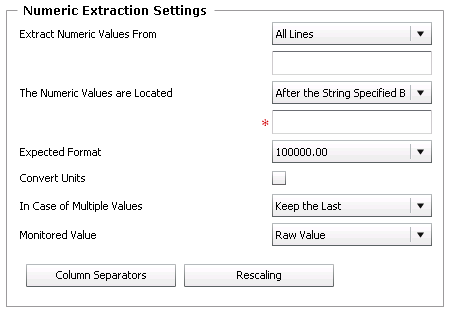
Extracting Numeric Value — Settings
| ▪ | Extract Numeric Values From: Select the option corresponding to the lines that will search for the numeric extraction: |
| ✓ | All Lines: All lines of the text will be scanned for the Numeric value search. There is no need to provide further information. |
| ✓ | The Line Numbers Below: Only specific line numbers will be scanned. The line numbers must be specified in the text field below. Line numbers are specified as follows: |
| • | x-y: all lines from x to y inclusive |
| • | x-: all lines from x to the end of the file inclusive |
If the "Skip blank lines" option is selected, empty lines will be ignored in the line-count.
| ✓ | Lines Matching the Regular Expression Below: The lines scanned will be the lines matching the regular expression specified in the field. |
| ▪ | The Numeric Values are Located: Select an option and enter a value in the field provided below: |
| ✓ | After/Before the String…: Indicate if the numeric value is located after or before the string to be entered in the text field. |
| ✓ | At the Character Offset…: The value should be at a specific character offset in the line. Enter the offset number in the box. The solution will look for the numeric value at that exact character offset in the line. If no numeric data is found, no value will be collected. |
| ✓ | In the Column Number…: The previously selected lines contain several columns identified by a separator character. Enter the column number that should contain the value and click the Column Separators button to specify how columns are separated. |
| ▪ | Expected Format: This option allows you to extract numeric values that use blank, comma or points as decimal and thousand separators. Monitoring Studio will look for a number in the location specified previously. When a character that does not match the expected format is found, the parsing stops. So, if the expected format is 1,000 and Monitoring Studio finds 1 000, the returned value will be 1.
Select the expected format for the value to be searched. |
| ▪ | Convert Units: Check this option to convert the extracted numeric value from kilobytes, megabytes, gigabytes, terabytes to bytes or from days, hours, minutes to seconds. (For example: 2.1 KB will be converted to 2150 bytes and 1 hour will be converted to 3600 seconds). |
| ▪ | In Case of Multiple Values: Select the option corresponding to the action you wish the solution to perform when multiple values are extracted: |
| ✓ | Keep the Last: Only the latest value found will be kept (default). |
| ✓ | Calculate the Average: The values found will be averaged and only the result will be kept. |
| ✓ | Calculate the Sum: The values found will be summed and only the result will be kept. |
| ✓ | Keep the First: Only the first value found will be kept. |
| ✓ | Select the Lowest: Only the lowest value found will be kept. |
| ▪ | Monitored Values: Select the option corresponding to the post-processing action you wish the solution to perform: |
| ✓ | Raw Value: The values are reported as collected. No post-processing is performed. |
| ✓ | Delta: The value reported corresponds to the difference between values collected during two consecutive polling. |
| ✓ | Delta per second/minute/hour: The value reported corresponds to the result of the division of the Delta by the number of seconds/minutes/hour elapsed between the collection times. |
 Delta calculation cannot be processed until at least two collects are performed. Delta calculation cannot be processed until at least two collects are performed.
| 9. | Specify the Column Separators options. Click the Column Separators button to display the following panel: |
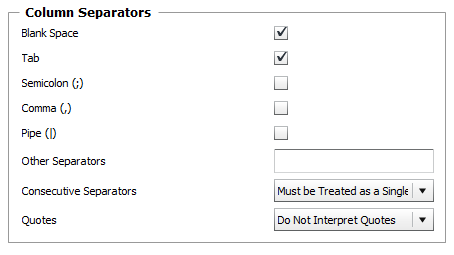
Extracting Numeric Value — Column Separator Configuration
| ▪ | Blank Space: A blank space will be considered as column separator. |
| ▪ | Tab: A tab will be considered as column separator. |
| ▪ | Semicolon (;): A semicolon will be considered as column separator. |
| ▪ | Comma (,): A comma will be considered as column separator. |
| ▪ | Pipe (|): A pipe will be considered as column separator. |
| ▪ | Other Separators: Enter the character(s) that will be considered as column separator(s). If you need to provide more than one character, simply type the separators one after another. |
| ▪ | Consecutive Separators: Select the way consecutive separator should be processed. |
| ✓ | Must be Treated as a Single One: Each consecutive separators must be treated as a single separator. |
| ✓ | Mean Empty Columns: Each separator is treated as an individual column separator and the column is considered empty. |
| ▪ | Quotes: Indicate how quotes will be considered: |
| ✓ | Do Not Interpret Quotes: All applicable separators will be considered as a column separator even when enclosed in quotes. |
| ✓ | Consider Text in "Double Quotes" as a Single Column: Numeric values enclosed in double quotes will be considered as a single column. Any separator found within double quotes will not be considered as a column separator. |
| ✓ | Consider Text in 'Single Quotes' as a Single Column: Numeric values enclosed in single quotes will be considered as a single column. Any separator found within single quotes will not be considered as a column separator. |
| 10. | Specify the Rescaling options. Click the Rescaling button to display the following panel: |

Extracting Numeric Value — Rescaling Configuration
| ▪ | Rescaling: Select an option to rescale the value that is being extracted in order to have a more readable graph in TrueSight Operations Management: |
| ✓ | Divide the value by a value that then gives you the reading in terms best suited to you |
| ✓ | Multiply the extracted value by a constant factor |
This can be useful if you extract numeric values in bytes but prefer to show a graph in megabytes. In such a case, you would divide the values by 1048576 (1024*1024).
| 11. | Define the Monitor Settings: |
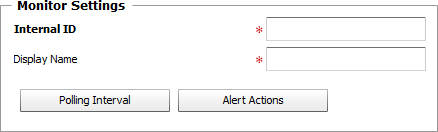
Extracting Numeric Value — Monitor Settings
| ▪ | Internal ID: Enter an ID to identify the monitored object. |
| ▪ | Display Name: Enter a name to identify the monitored object in the Console. |
| ▪ | Optional — Alert Actions: Define the action(s) Monitoring Studio needs to perform when the thresholds for this instance is breached. |
| 12. | Click the Add to List button to complete the creation of the Numeric Extraction instance. |
|


