|
This section details the various connection settings available for performing queries on database servers other than Microsoft SQL, MySQL, Oracle or PostgreSQL. First steps are common to all database queries and connection methods. They are described in the Analyzing a Database Query chapter.
Configuring a connection to another database server
| 1. | Define the Connection Settings to the other database server: |

Other Database - Connection Settings
| ▪ | JDBC URL: Enter the URL to use for connecting to the JDBC database. You can use the %{SEN_USERNAME}, %{SEN_PASSWORD} and %{SEN_PASSWORD} macros to insert the username and password (Example: jdbc:postgresql://hostname:5432/dbname). |
| ▪ | Driver Class: Enter the driver class for the JDBC database (Example: org.postgresql.Driver). |
| ▪ | Username: Enter the username to use to connect to the database. Leave blank to use the username provided at the Host level. |
| ▪ | Password: Enter the password associated with the specified username. Leave blank to use the password provided at the Host level. |
 Connection Settings will be shared by all the queries defined within the database Monitor. Connection Settings will be shared by all the queries defined within the database Monitor.
| 2. | Define the SQL Query and Timeout properties: |
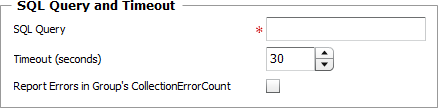
Other Database - Query and Timeout Settings
| ▪ | SQL Query: Enter the SQL query you wish to perform. |
| ▪ | Timeout (seconds): Specify the time in seconds after which the query will be stopped. (Default: 30 seconds). If the query times out, the Status attribute of the Studio Database Query Monitor Type will be set to 2 (Failed) and an alarm will be triggered in TrueSight Operations Management. |
| ▪ | Report Errors in Group's CollectionErrorCount: Select this option to have the Collection Error Count attribute of the Group Monitor reflect possible alerts triggered upon the query execution. The Collection Error Count attribute of the Group reports on the collection errors of all Monitors, associated to the Group, for which this option is available and selected, providing a global view of the collection errors for the whole Group. |
| 3. | Define the Monitor Settings: |
| ▪ | Internal ID: Enter an ID to identify the managed database query instance in TrueSight Operations Management. |
| ▪ | Display Name: Enter a name to identify the managed database query instance in TrueSight Operations Management. |
| ▪ | Optional — Polling Interval: Set the frequency at which the data collection will be performed. Default is 2 minutes. |
| ▪ | Optional — Alert Actions: Define the action(s) Monitoring Studio needs to perform when the thresholds for this database query instance is breached. |
| 4. | Optional — Define the Content Processing rules you wish to apply to the database query output: |
| ▪ | String Searches: Define the search criteria for a specific string you wish to find or not find in the database query output. |
| 5. | Click the Add to List button to complete the creation of the database query instance. |
|


