|
The Multi-Parameter Formula feature can monitor all the KMs that are loaded in your PATROL Console. This feature more precisely extracts other KMs' Parameter values and computes them with a mathematical formula or a pre-defined PSL function. The returned value can be used to perform additional operations such as converting units, performing correlation, etc.
|
TrueSight Operations Management and PATROL platforms:
Monitor Type in TrueSight Operations Management
|
Class in PATROL
|
Studio Folder
|
SEN_MS_FOLDER
|
Attribute in TrueSight Operations Management
|
Parameter in PATROL
|
File Count
|
FileCount
|
|
The objects created are instances of the Studio Multi-Parameter Formula monitor type.
To create a multi-parameter formula
| 1. | Access the Monitoring Studio Configuration panel, as explained in the Configure Monitors chapter. |
| 2. | In the Monitors section, click the Multi-Parameter Formula button. |
| 3. | The Multi-Parameter Formula panel is displayed to define the formula settings. |
| 4. | Specify the parameters to use in the formula: |
| ▪ | Optional — Check the Using Objects Display Names option to allow the use of instance labels instead of PATROL IDs to define a parameter's path. This option may be particularly useful when an object ID is unknown. |
| ▪ | Enter up to 10 parameters and their paths in the A to J fields using the following formats: |
| ▪ | <class-name>/<instance-name>/<parameter-name> (if the Using Objects Display Names is not selected). |
| ▪ | <class-name>/<instance-label>/<parameter-name> (if the Using Objects Display Names is selected). |
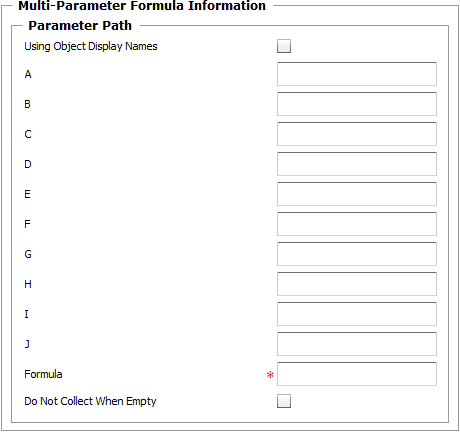
Monitoring a Loaded KM — Parameter(s) Selection Page
| 5. | Define the formula to apply to the monitored parameter(s): |
| ▪ | Formula: Enter the formula you wish to apply to the parameter(s). The parameters are identified by a letter listed in the dialog box. Construct the required formula using: |
| ▪ | The uppercase letter preceding the parameter (A, B, etc.).
 Parameter path 'A' is not recorded in BMC TrueSight Operations Management v10.5. To avoid this issue, leave the 'A' field blank and move the parameter paths to B, C, etc. Parameter path 'A' is not recorded in BMC TrueSight Operations Management v10.5. To avoid this issue, leave the 'A' field blank and move the parameter paths to B, C, etc. |
| ▪ | PSL operators: addition (+), subtraction (-), multiplication (*), division (/) concatenation (.), bitwise (&), etc. |
Here are some examples of use for each predefined PSL function:
To join two different tables from text parameters:
The swTableJoin() PSL function is used to join two different tables from text parameters:
| • | swTableJoin(tableA, separatorsA, keyColumnA, tableB, separatorsB, keyColumnB, defaultRightLine, keyType, timeout) |
where:
| • | tableA is the left table derived from text parameter A |
| • | separatorsA are the separators that separate the columns in tableA |
| • | keyColumnA is the key column number in tableA used for matching the key columns in tableB |
| • | tableB is the right table derived from text parameter B |
| • | separatorsB are the separators that separate the columns in tableB |
| • | keyColumnB is the key column number in tableB used for matching the key columns in tableA |
| • | defaultRightLine (optional) default rightTable line, when a match is not found |
| • | keyType (optional) key type such as wbem used by Matsya TableJointClient used by the Java client. |
| • | timeout (optional) timeout for the table joint query. |
Example:
swTableJoin(A, "|", 1, B, "|", 1)
where:
| • | Table 1 (in parameter A: path1/Result): |
key 1|A|B|C|
key 2|aa|bb|cc|
key 3|1|2|3|
| • | Table 2 (in parameter B: path2/Result): |
key 1|X|Y|Z|
key 2|xx|yy|zz|
key 3|4|5|6|
The returned output is a table that is set to the Result text parameter:
key 1;A;B;C;key 1;X;Y;Z;
key 2;aa;bb;cc;key 2;xx;yy;zz;
key 3;1;2;3;key 3;4;5;6;
|
To find the minimum value among several parameters:
Use the swGetMinimum() PSL function to find the minimum value for the chosen list of parameters (where A and B are number parameters):
To find the maximum value among several parameters:
Use the swGetMaximum() PSL function to find the maximum value for the chosen list of parameters (where A and B are number parameters):
To find the average value among several parameters:
Use the swGetAverage() PSL function to find the average value for the chosen list of parameters (where A and B are number parameters):
The returned output of the swGetMinimum, swGetMaximum, and swGetAverage PSL functions will be displayed by the Value attribute.
 If the formula or parameters entered are not PSL compatible, an error will be reported in the Group's CollectionErrorCount parameter. If the formula or parameters entered are not PSL compatible, an error will be reported in the Group's CollectionErrorCount parameter.
| ▪ | Do Not Collect When Empty: Select this option if you wish to skip the collect when one or more parameters is not populated (usually after a PATROL Agent restart). |
| 6. | Define the Monitor Settings: |
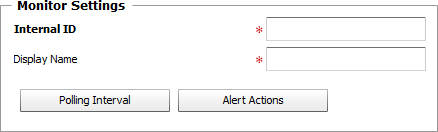
Multi-Parameter Formula — Monitor Settings
| ▪ | Internal ID: Enter an ID to identify the Multi-Parameter Formula instance in TrueSight Operations Management. |
| ▪ | Display Name: Enter a name to identify the Multi-Parameter Formula instance in TrueSight Operations Management. |
| ▪ | Optional — Polling Interval: Set the frequency at which the data collection will be performed. Default is 2 minutes. |
| ▪ | Optional — Alert Actions: Define the action(s) Monitoring Studio needs to perform when the thresholds for this Multi-Parameter Formula instance are breached. |
| 7. | Optional — Define the Content Processing rules you wish to apply to the Multi-Parameter Formula output: |

File (Flat or Log) — Content Processing Settings
| ▪ | String Searches: Define the search criteria for a specific string you wish to find or not find in the Multi-Parameter Formula output. |
| ▪ | Numeric Extractions: Define any numeric value to be extracted from the Multi-Parameter Formula output. |
| 8. | Click the Add to List button to complete the creation of the Multi-Parameter Formula instance. |
|


